

Vinyl Windows in San Bernardino, CA

Plain answers about vinyl windows for San Bernardino homes: how frames and glass handle hot summers, Santa Ana winds and dust, how retrofits fit stucco walls, and what to check before you choose an installer.

What We Cover

Vinyl Windows in San Bernardino, CA

Vinyl windows suit San Bernardino because the climate punishes weaker frames and glass. Summers run long and hot with strong sun, and dry Santa Ana winds push dust against every gap in a wall. Across San Bernardino County, from Muscoy to Loma Linda and Redlands, many older stucco homes still carry tired frames that leak air and grit.

The region sits near the San Andreas Fault, so a window has to be set square and fastened solidly in the opening. Homes along the old U.S. Route 66 corridor, near California State University, San Bernardino, and in the foothills by the Arrowhead Springs Hotel all see typical wind and sun exposure, and the same basics apply to each.

How Vinyl Frames Are Built

A vinyl frame is extruded PVC with hollow chambers running through it. More chambers add stiffness, so the frame resists bowing under load and wind pressure. Those chambers also trap air, which slows heat flow through the frame.

Why the Glass Package Matters Most

Most of a window's energy performance comes from the glass package, not the frame. That package is dual panes, a low-E coating, gas fill between the panes, and the spacer at the glass edge. In a hot inland summer, the coating and spacer decide how much heat gets through and how well the edge seals over time.

NFRC Label and Installation Method

The NFRC label gives the numbers worth comparing. U-factor measures heat flow, and lower insulates better. Solar Heat Gain Coefficient measures how much solar heat passes through, and lower blocks more. Visible Transmittance measures daylight.

Installation comes in two forms. A retrofit (insert) window sets inside the existing frame, which leaves the stucco mostly alone. Full-frame replacement removes the old frame down to the rough opening, which allows repair of hidden damage and fresh flashing. Stucco condition and frame condition decide which one fits.

Guides

The guides on this site cover home preparation, glass packages for hot summers, retrofit versus full-frame on stucco homes, timing around heat and Santa Ana winds, fixing fogging, sticking, and dust problems, and choosing quality windows and a good installer.

Before signing anything, run this short checklist: read the NFRC label, ask about the install method, and check the warranty terms.

Latest Guides

New homes under construction in Elk Grove, CA, showcasing modern architectural design.

Vinyl Window Earthquake Performance in San Bernardino

2026-10-26

Vinyl windows hold up reasonably well when the ground shakes, but the frame is rarely the part that fails. The glass is. A vinyl frame flexes under the sideways racking of a wood-frame stucco wall, and the pane breaks only when the opening distorts enough to force a glass edge or corner against the frame. No window is earthquake proof, and none can be guaranteed not to break, so the useful question is which details make breakage less likely and less dangerous.

Why the Glass Breaks Before the Frame
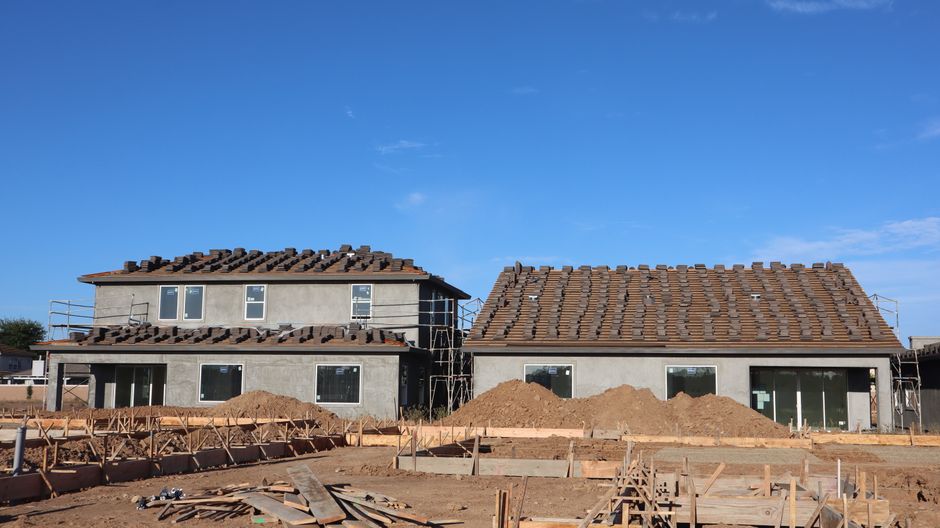
Two newly constructed houses with scaffolding under a clear blue sky.

In strong shaking, a house wall does not stay rectangular. It racks, and every window opening in it becomes a slightly tilted parallelogram. Vinyl is forgiving here because it bends and springs back. Glass does not bend, so it takes the load at its corners.

That is why the way glass is set inside the frame matters more than the frame material. In a well-made unit, the pane rests on small setting blocks with a gap around its edges. Glass that floats a little can ride out distortion. Glass pinched tight against the frame has nowhere to go and tends to crack at a corner first.

When shopping or inspecting, ask the installer or manufacturer how the glass is set. Cheap or poorly glazed units with tight glass-to-frame contact are the ones most likely to crack.

Corners Tell You About Frame Quality

Front view of a brick building facade with sash windows and a wooden bench.

Look at the corners of a vinyl window. Fusion-welded corners hold the frame square under racking better than mechanically joined ones. A crack or open seam at a corner is a reason to repair or replace the unit, whether or not a quake ever happens.

How the Installation Changes the Outcome

A window can only tolerate as much distortion as its opening allows. A properly shimmed unit with a small perimeter gap absorbs some movement. A unit jammed tight into the opening takes all of it.

Keep the Perimeter Gap Flexible

The gap around a window should be filled with low-expansion window foam, or backer rod and flexible sealant. Rigid fill such as mortar or overpacked high-expansion foam turns the frame into a brace and passes wall movement straight to the glass.

Fasten as the Manufacturer Directs

Screws go through the frame at the shim points the manufacturer specifies. More screws or tighter screws do not make a window hold up better. Over-driven fasteners bow the vinyl jamb inward, which pre-stresses the glass and makes the sash bind before any quake arrives.

Retrofit Units in Existing Stucco

Many San Bernardino replacements are retrofit or flush-fin units set into existing stucco, which avoids tearing off the exterior. The result depends on the old opening being square and sound. Before replacement, check the sill for rot, termite damage or old water damage. A weak sill gives the new window nothing solid to bear on.

Weep Holes Stay Open

Vinyl windows drain through slots at the bottom of the frame. After installation or any repair, make sure sealant or debris has not blocked them. Never caulk over weep holes.

Choosing Glass Where People Walk and Sleep

Tempered glass is worth choosing for large panes near floors, beside doors, in patio doors and over bathtubs. It does break, but into small, blunter pieces. Laminated glass cracks yet stays held by its interlayer, which keeps shards in the frame and the opening closed. For keeping an opening intact after a break, laminated is the stronger choice.

Safety film helps a little, but only when it is anchored into the frame with an attachment system rather than applied to the visible glass alone. It can hold broken shards together; it does not stop glass from breaking. Taping an X on a window does not prevent breakage either.

Sliding Patio Doors Need Extra Attention

Strong shaking can bounce a heavy sliding panel off its track. Confirm the door has working anti-lift blocks or clips in the head track, and that the fixed panel is screwed down as designed.

Grit is the everyday problem. Santa Ana winds and the dust that pours through Cajon Pass pack sliding tracks, and a dirty track makes a sash stick. A sticking sash is harder to open in an emergency. Vacuum the tracks and check that the rollers turn freely.

Foothill Homes Face the Most Intense Shaking

The San Andreas Fault runs very close to the base of the San Bernardino Mountains. Homes in Verdemont and the neighborhoods near California State University, San Bernardino sit nearest it, and near-fault sites can expect stronger, more abrupt shaking. For these homes, laminated glass, careful installation and secured patio doors pay off most.

Heat Stresses Vinyl Long Before a Quake

Inland Empire summers add their own wear. Vinyl expands and contracts more than wood or aluminum, and hot days followed by cool nights cycle it constantly. Dark-colored vinyl in full western or southern sun runs hottest. Choose a frame color and grade rated for high heat, and leave the expansion allowance the manufacturer specifies. A frame that is already distorted by heat has less margin when the walls move.

The House Matters More Than the Window

Window features cannot make up for a house that moves on its foundation. In older raised-floor homes with cripple walls, a shift at the foundation racks every window opening at once. Foundation bolting and cripple wall bracing do more for window survival than any window feature. Replacing windows does not make the house itself more earthquake resistant.

Enlarging an opening also changes how the wall resists shaking. Turning a small window into a wide picture window or slider removes wall that may be doing bracing work. Before cutting a bigger opening, have a qualified engineer or experienced contractor evaluate the wall and the header.

Bedroom Windows Are an Exit

Test each bedroom window regularly and make sure it opens fully by hand. Do not block it with a dresser or bed. For security, use removable track stops on sliders rather than screwing them permanently shut.

Move beds and cribs away from big panes. Most home quake injuries come from falling objects and broken glass. Keep sturdy shoes and a flashlight by the bed, because floors near windows may be covered in glass after a strong event.

What to Check After a Noticeable Quake

Walk every window and look for:

  • cracked glass, especially at corners
  • sashes that now bind or will not lock
  • sealant pulled away from stucco
  • gaps between frame and wall
  • cracked frame corners

A window that worked fine yesterday and binds today usually means the opening has shifted.

Fog Between the Panes

Shaking can break the edge seal of a dual-pane unit without cracking the glass. Moisture then gets in, and haze or condensation shows up between the panes in the following weeks. Usually only the glass unit or sash needs replacing, not the whole window.

Stucco Cracks at the Corners

Diagonal cracks running from window corners are common after shaking and are often from shrinkage alone. Hairline cracks are usually cosmetic but can let water in. Cracks that are wide, offset or growing deserve a professional look, because they can signal framing movement. Not every crack means structural damage, and a crack that looks minor is not proof the wall is fine.

Be Ready for a Broken Pane

Keep plastic sheeting and tape on hand. A broken pane in hot or windy weather needs a temporary cover until a glazier can replace the glass unit. Note your window brand and any label or etching on the glass now, so a replacement can be ordered quickly when it is needed.


Read more →

Contemporary A-frame house with large glass windows on a sunny day, surrounded by greenery.

Can Vinyl Windows Cut Street Noise in San Bernardino?

2026-10-26

Vinyl windows can cut traffic and street noise in San Bernardino, but the vinyl is not what does the work. The glass package, the seals and the way the window is installed decide whether a house gets noticeably quieter or just gets new frames. Expect a softer, calmer room, not a silent one.

Where the biggest gains show up

Two white-framed windows on a vibrant yellow building facade in Büsum, Germany.

The improvement is largest when the old windows are single pane aluminum sliders. Many mid century and 1970s to 1980s San Bernardino homes still have them. Thin glass and worn, loose sweeps let sound pass easily, so replacing them with a tighter, better glazed unit makes a clear difference.

If the current windows are already decent double pane units, the gain is smaller. A double pane window is not automatically much quieter than a single pane one. Two thin matched panes with a narrow gap can perform about the same at low frequencies, which is where truck rumble lives.

Air leaks matter more than glass

Unrecognizable professional male worker assembling white window with cordless screwdriver with drill near windowsill with reflection on glass during repair works in apartment

Sound travels wherever air travels. Before spending anything, close an existing window and look for daylight at the meeting rail and along the track. On a windy day, feel for drafts around the sash and frame. Any spot where air moves is a spot where noise moves.

That is why a well sealed window with ordinary glass can beat a poorly sealed one with fancier glass. Tight sealing is the foundation, and everything else builds on it.

Read the right rating: STC versus OITC

Two ratings show up on window specifications, and they measure different things.

  • STC (Sound Transmission Class) reflects mid and high frequencies, such as voices and the hiss of tires.
  • OITC (Outdoor Indoor Transmission Class) better reflects low frequency noise from trucks, buses and trains.

For a home near I-215, I-10 or the rail corridors, OITC is the more useful number. A high STC alone does not guarantee relief from truck and train rumble. When comparing windows, ask for both ratings and make sure each is tied to the exact glass package listed, not to the product line in general.

Glass upgrades that actually reduce noise

Laminated glass

Laminated glass has a plastic interlayer bonded between glass sheets that damps vibration. It is one of the most effective noise upgrades available. It can be ordered for only the street facing or highway facing windows, which keeps the project practical.

Asymmetric glazing

Asymmetric glazing means two panes of different thickness in one sealed unit. Matched panes tend to resonate at the same frequency and pass sound at that pitch. Mixing thicknesses breaks that up, so asymmetric glass reduces noise better than two equal panes.

A wider airspace

A wider gap between panes generally helps with low frequencies. Very narrow gaps add little over single glass at bass pitches.

What does not help

Several popular features are thermal, not acoustic. Argon gas fill is mainly about heat. Low-E coatings affect heat and light, not sound. Triple pane is also not always the best choice for noise, since laminated or asymmetric double pane often matches or beats it.

What the vinyl frame contributes

The frame matters through its construction. A multi chambered, well welded frame with continuous weatherstripping blocks sound better than a thin, lightly built one. Still, the glass package and the airtightness of the installation do most of the work. The vinyl material itself is not what blocks sound.

Choose operating styles for the noisy wall

Casement and awning windows close by pressing against compression gaskets, so they usually seal tighter than sliders. Fixed picture windows seal best of all. On the wall facing the freeway or a busy street, consider fixed or casement units wherever a slider is not truly needed.

Sliders depend on brush or fin weatherstrip that wears over time. Santa Ana wind events push fine dust into tracks, and that grit grinds the pile down faster. Vacuum the tracks after wind events, check the weatherstrip about once a year, and replace it when it is flattened or missing.

Installation can undo a good window

A quiet window installed badly is a loud window. The space between the window and the rough opening should be filled with low expansion foam, or backer rod and sealant, not left hollow or stuffed loosely.

Most local homes are stucco, so installers often choose a retrofit insert or flush fin window to avoid cutting the stucco. That can work well, but ask exactly how the perimeter will be sealed at the stucco face. A sloppy caulk joint there becomes both a sound leak and a water leak.

Full frame replacement involves more labor and stucco repair, but it lets the installer correct a rotted or out of square opening and seal it properly. On the one wall that faces the freeway, it can be worth it.

Local conditions that affect results

Heat and movement

Inland summers are hot, and vinyl expands and contracts with temperature. Perimeter sealant needs to be movement capable and applied at the correct joint width. Joints that crack open over a few summers reopen sound paths, so check the perimeter caulk each spring.

Dark vinyl absorbs more heat, and some dark frames can distort if they are not rated for high heat exposure. On sun baked south and west walls, confirm the color is rated for that exposure, or choose a light frame.

Freeways, rail and wind

Homes in Verdemont and other north end areas near I-215 and the Cajon Pass corridor can face steady truck noise and strong wind. Wind pressure on poorly sealed sliders adds whistling. On the side facing the freeway or the prevailing wind, prioritize airtight units and laminated glass.

Near the rail yards close to downtown and along the line climbing toward Cajon Pass, diesel and locomotive rumble is the hardest noise to block. Windows soften it. They do not erase it.

Ground movement

San Bernardino sits close to the San Andreas Fault. After any noticeable shaking, walk the house and inspect window perimeter caulk and the stucco around the openings for new cracks. Seal what you find, since gaps let in both sound and dust.

Do not seal the weep holes

Weep holes at the bottom of the frame must stay open so water can drain. Caulking them shut in an attempt to stop noise is a mistake. They contribute very little to sound, and blocking them can trap water in the frame. Caulking every gap is not a good way to soundproof a window.

Other weak points that cap the result

Even the best windows cannot overcome the other openings in the wall. Hollow core doors, mail slots, attic vents and wall mounted AC units facing the street all let noise in. If quiet is the main goal, address them in the same project.

Window coverings add only modest help. Heavy lined curtains can take the edge off high frequency noise and room echo, but they do not replace a well sealed window.

Test before and after

Note when the noise peaks, such as rush hour or a freight train pass. Stand in the same spot with the windows closed and take a reading with a phone decibel meter app, before and after the work. Treat the numbers as rough comparisons, not precise measurements. Your own ears in the same room at the same hour are just as useful.

Questions to ask when getting quotes

  • What are the STC and OITC ratings for each window, with the specific glass package listed?
  • Is laminated or asymmetric glass available on the openings facing the street or freeway?
  • How will the perimeter be sealed, especially at the stucco face?
  • What does the warranty cover for seal failure between panes?

Clear answers to these four questions say more about the likely result than any brochure claim. A home near a freeway or rail line will not become silent, but with the right glass, tight seals and careful installation, the daily noise level can drop in a way you notice.

Read more →